AI Infrastructure Scaling Checklist for Tech Leaders

An AI infrastructure scaling checklist is a systematic framework for evaluating production readiness across data pipelines, compute resources, orchestration, monitoring, and security. Over 80% of AI projects fail to scale successfully due to infrastructure gaps. That statistic means most teams hit a wall not because their models are wrong, but because the infrastructure beneath them was never built for production volume. This checklist covers the five domains that determine whether your AI systems grow reliably or collapse under load.
1. Is your data pipeline production-grade and scalable?
A production-grade data pipeline handles 10x your current volume without manual intervention. Most pipelines built during prototyping lack automated data quality checks, schema validation, and drift monitoring. Those gaps become critical failures when traffic spikes or upstream data sources change without warning.
What to check:
- Volume headroom: can the pipeline process 10x current throughput without redesign?
- Automated data quality gates that reject malformed or out-of-distribution records before they reach the model
- Data drift monitoring that alerts when input distributions shift beyond acceptable thresholds
- End-to-end lineage tracking so you can trace a bad prediction back to its source record
- SLA-backed ingestion latency with alerting when pipelines fall behind
Brittle pipelines cause silent performance degradation. A model that was 94% accurate in testing can drop to 78% in production simply because upstream data changed and no one noticed. Observability tools like Apache Kafka for streaming ingestion and Great Expectations for data validation give you the visibility to catch these regressions before users do.
Pro Tip: Set pipeline health as a first-class KPI alongside model accuracy. Track record rejection rates, ingestion lag, and schema drift weekly. A spike in any of these metrics predicts a model performance drop before it shows up in user-facing metrics.

2. How to stress-test and right-size your AI compute infrastructure
Compute right-sizing is the most misunderstood part of scaling AI. Viewing AI infrastructure purely as GPU procurement is a mistake. Power density, cooling capacity, and network throughput become the primary bottlenecks as workloads scale. Adding GPUs without addressing these physical constraints produces diminishing returns fast.
Performance benchmarks to hit:
- p95 latency below 800 milliseconds for interactive AI applications
- Load tested at 3–5x expected peak traffic before any production launch
- GPU utilization above 70% during peak periods to justify hardware spend
- Storage throughput and concurrent access capacity matched to GPU cluster size
Model quantization and dynamic batching reduce operational costs more effectively than simply adding hardware. Quantization shrinks model weights from 32-bit floats to 8-bit integers, cutting memory requirements by up to 4x with minimal accuracy loss. Dynamic batching groups multiple inference requests together, improving GPU utilization without changing the model at all.
Vertical scaling (larger instances) works well up to a point. Horizontal scaling (more instances behind a load balancer) handles bursty traffic better and gives you fault tolerance. The right choice depends on your request pattern. Steady, high-volume workloads favor vertical. Spiky, unpredictable traffic favors horizontal.
Scaling tensor parallelism lowers latency but increases communication overhead, requiring expensive high-speed interconnects. That trade-off means you need to model the cost before committing to a distributed inference architecture.
Pro Tip: Monitor GPU utilization and storage throughput together, not in isolation. Storage tier scaling without matching throughput or concurrency leads to GPU starvation. Your GPUs sit idle waiting for data, and your cost-per-inference climbs while throughput drops.
3. What orchestration and control plane considerations ensure platform scalability?
Orchestration is where most scaling plans break down. Persistent multi-agent AI workloads impose extreme demand on the orchestration control plane. High-frequency state updates and lookups create bottlenecks that no amount of GPU capacity can fix.
Orchestration readiness criteria:
- Horizontal scaling of the control plane, not just the inference layer
- Queue smoothing to absorb burst traffic without dropping requests
- Concurrency caps per tenant or workflow to prevent one workload from starving others
- Backpressure thresholds that signal upstream systems to slow down before queues overflow
- Multi-region routing with data replication for resiliency and latency reduction
Orchestration layers must scale horizontally and handle bursty agent workflows to prevent system collapse regardless of GPU capacity. This is the insight that separates teams who scale successfully from those who don’t. A well-provisioned GPU cluster behind a poorly designed orchestration layer will still fail under load.
Run failure drills regularly. Simulate burst traffic at 5x normal volume. Inject degraded inputs and malformed requests. Test what happens when one region goes offline. These drills reveal control plane weaknesses before your users do. Score your readiness across orchestration domains using a structured framework, and treat any domain scoring below threshold as a production blocker.
4. Which monitoring, observability, and cost control mechanisms optimize scalability?
Multi-layer observability is the difference between catching a problem in staging and discovering it during a production incident. Most teams monitor infrastructure metrics but miss the application and data tiers. That gap means you see CPU and memory alerts but miss model drift, cost overruns, and silent accuracy degradation.
Monitoring layers to implement:
- Infrastructure KPIs: CPU, GPU utilization, memory, network throughput, and storage IOPS
- Application KPIs: request latency, error rates, queue depth, and throughput per endpoint
- Data KPIs: input drift, output distribution shifts, and prediction confidence scores
- Cost KPIs: cost per 1,000 predictions, cost per active user, and cost per workflow run
Enterprise AI infrastructure spending is projected to increase 2–3x by 2030. That trajectory makes unit economics non-negotiable. Cost per inference is the metric that tells you whether your AI product is economically viable at scale. Track it from day one, not after you’ve already overprovisioned.
Chargeback and showback strategies assign infrastructure costs to specific teams or products. Showback reports costs without billing internally. Chargeback actually transfers costs. Both approaches create accountability and surface workloads that are consuming disproportionate resources without delivering proportional value.
Pro Tip: Build a real-time dashboard that shows cost per inference alongside latency and error rates. When cost per inference rises while latency stays flat, you have a resource efficiency problem. When both rise together, you have a capacity problem. The distinction changes your response entirely.
5. How to ensure security and compliance frameworks scale with AI workloads?
Security frameworks that work at 100 requests per second often break at 100,000. Manual review processes, static access controls, and point-in-time compliance audits cannot keep pace with production AI workloads. Scalable security requires automation built into the orchestration layer itself.
Security and compliance checklist:
- Zero-trust architecture with per-request authentication and authorization, not session-based trust
- Synthetic data pipelines for model training and testing that protect sensitive production records
- Policy enforcement integrated directly into the orchestration control plane, not bolted on afterward
- Multi-region compliance constraints that route data to the correct jurisdiction automatically
- Continuous security validation through automated scanning, not quarterly manual audits
- API key management with granular scopes, rotation schedules, and usage monitoring
AI readiness is scored across five domains: data, memory, orchestration, monitoring, and security. Security is the domain most often treated as an afterthought. Teams that integrate security automation early spend far less time remediating compliance failures at scale.
Regulatory requirements like GDPR, HIPAA, and SOC 2 do not get simpler as your AI workloads grow. They get harder. Multi-region deployments add data residency constraints. Higher request volumes increase the blast radius of any breach. Build compliance into your architecture from the start, and automate validation so it runs continuously rather than on a schedule.
Key Takeaways
A successful AI infrastructure scaling strategy requires readiness across data, compute, orchestration, monitoring, and security before production traffic arrives.
| Point | Details |
|---|---|
| Data pipeline readiness | Pipelines must handle 10x volume with automated quality checks and drift monitoring. |
| Compute right-sizing | Use model quantization and dynamic batching before adding hardware to cut costs. |
| Orchestration first | Scale the control plane horizontally or bursty workloads will collapse the system. |
| Unit economics matter | Track cost per 1,000 predictions from day one to keep spending accountable at scale. |
| Security automation | Integrate zero-trust and compliance validation into orchestration, not as an add-on. |
What I’ve learned from watching AI scaling projects fail
The pattern I see most often is this: a team builds a working prototype, gets stakeholder approval, and then tries to scale it by throwing more compute at the problem. It almost never works. The failures I’ve watched up close were not GPU failures. They were orchestration failures, data pipeline failures, and cost modeling failures.
The uncomfortable truth about scaling AI is that production performance gains come from architecture and orchestration decisions, not last-minute model tweaks. Teams that invest in orchestration and monitoring early ship faster and spend less. Teams that skip those layers spend months firefighting incidents that were entirely predictable.
Overprovisioning without cost modeling is the other trap I see constantly. A team provisions a GPU cluster for peak load, runs it at 20% utilization for six months, and wonders why the unit economics don’t work. Continuous readiness evaluation, including load testing and economic viability analysis at each growth phase, is what separates teams that scale confidently from those that scale expensively.
My advice: score your infrastructure across all five domains before you scale. Fix every domain below threshold before you add capacity. And treat cost per inference as a product metric, not an ops metric.
— Kendell
Infrax makes AI infrastructure management practical
Scaling AI infrastructure requires visibility across every request, every model, and every cost center. Infrax gives you that visibility through a unified API gateway that routes each request to the right model based on your cost, latency, and quality requirements.
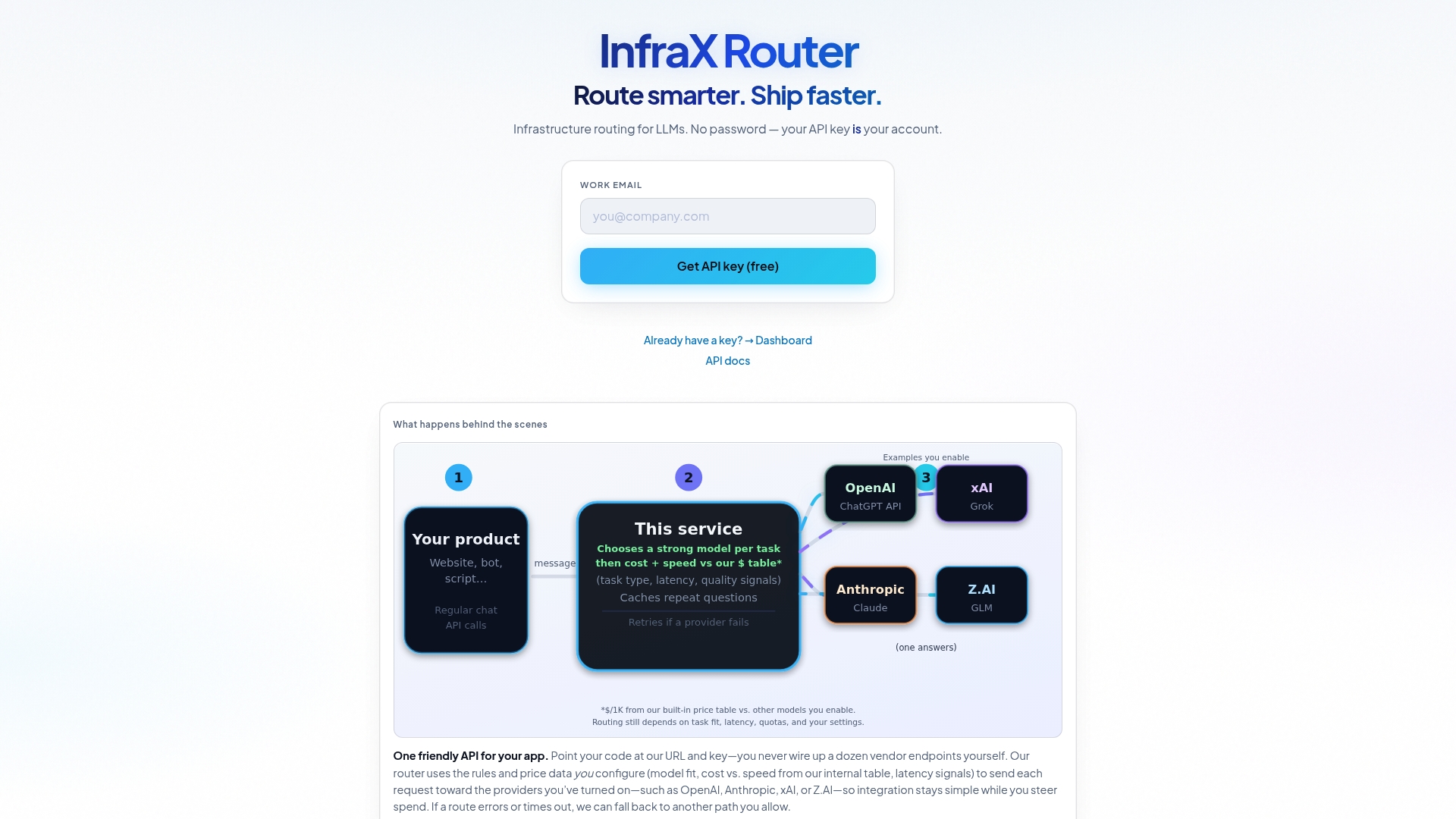
With Infrax, you get real-time monitoring, automatic failover, response caching, and centralized API key management in one platform. You stop guessing which model is performing and start routing with data. Whether you’re running a SaaS product or an enterprise AI workload, Infrax keeps your infrastructure accountable and your costs visible. Get your AI Router API key and start routing requests with full cost and performance observability from day one.
FAQ
What is an AI infrastructure scaling checklist?
An AI infrastructure scaling checklist is a structured framework for evaluating production readiness across data pipelines, compute resources, orchestration, monitoring, and security. It identifies gaps before they cause failures at scale.
Why do most AI projects fail to scale?
Over 80% of AI projects fail to scale due to infrastructure gaps, not model quality. The most common failures involve brittle data pipelines, under-designed orchestration layers, and missing cost controls.
What latency target should I set for AI inference?
The standard p95 latency target for interactive AI applications is under 800 milliseconds. Systems should be load tested at 3–5x expected peak traffic before any production launch.
How do I control AI infrastructure costs at scale?
Track cost per 1,000 predictions as a primary unit economic metric. Apply model quantization and dynamic batching before adding hardware, and use chargeback strategies to assign costs to specific workloads.
What does zero-trust mean for AI infrastructure?
Zero-trust AI security means every request is authenticated and authorized individually, with no session-based trust. Policy enforcement runs inside the orchestration layer and applies per-request, not per-session.